
HDB household shelter · Singapore
L-Shaped Rack Transforms Your HDB Bomb Shelter
A household shelter is the most awkward room in the flat: too small to furnish, too useful to waste, and you are not allowed to put a single screw in it. An L-shaped rack is the one piece of storage that solves all three at once.
It stands on the floor rather than the wall, it turns the corner so both usable walls do work, and it goes in and out through the shelter door in pieces. Most installations take under an hour.

Why nothing fits
Four constraints, and only one of them is the size
People usually blame the floor area when a shelter defeats them, but the room is rarely the real problem. It is the combination: a fixed door swing, a wall you cannot fix anything to, two walls of unequal length, and a vent that has to stay clear. Solve those four and there is more space in there than it looks.
Nothing may be drilled
The walls, floor and ceiling of a household shelter are reinforced concrete and are not to be drilled, nailed or plugged. That rules out wall-mounted shelving, brackets and anything that needs an anchor.
The door has to stay clear
The shelter door is heavy and it sweeps a quarter-circle of floor as it opens. Whatever goes in has to leave that arc completely free, which usually costs you the first stretch of one wall.
The room is small and off-square
A household shelter is rarely a tidy rectangle you can furnish from a catalogue. The two usable walls are often different lengths, and a rack sized for one of them will not fit the other.
The vent must not be blocked
There is a ventilation opening set into one of the walls, usually high up. Keep shelving and stored boxes away from it rather than building right across it.
If a supplier offers to drill, bracket or anchor anything to your household shelter, stop. Nothing should be fixed to the shelter’s walls, floor or ceiling — a free-standing boltless L-shaped rack with no centre pole is the correct way to store in one.
One wall, or two?
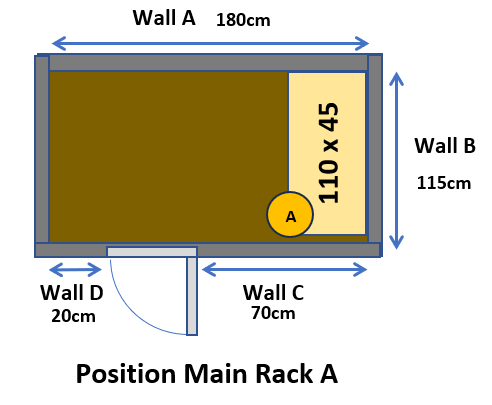
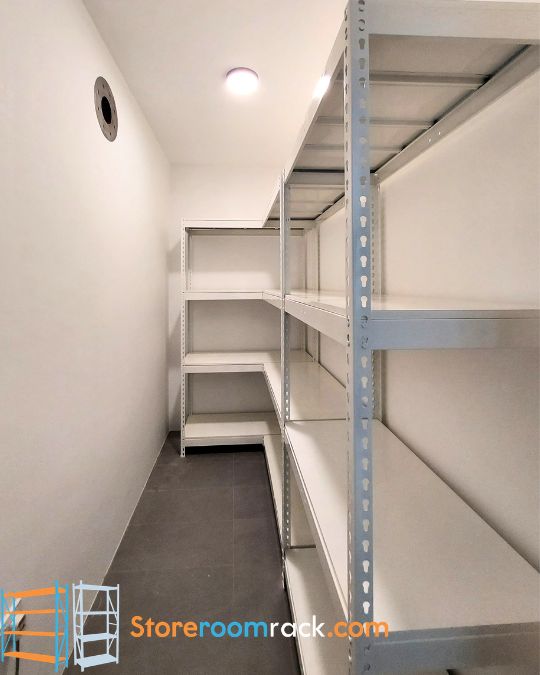
The same room, planned two ways. A single bay is cheaper and quicker; turning the corner roughly doubles the shelf area without taking any more standing space.
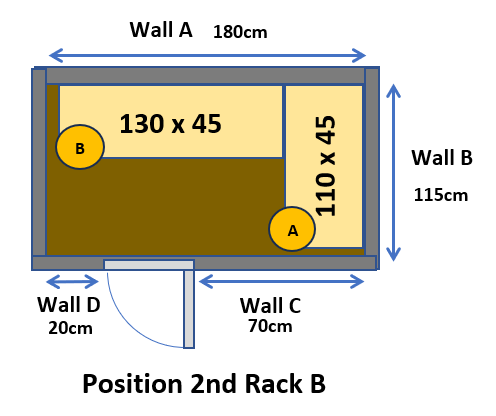
L-shaped, two walls
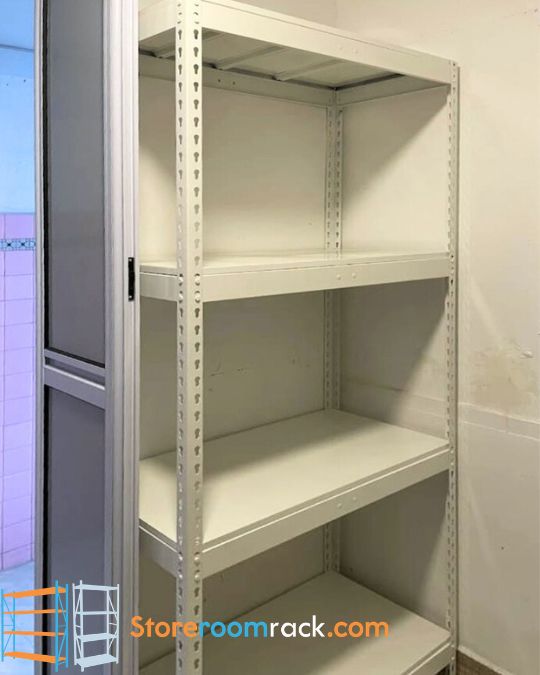
The single-bay build, in place
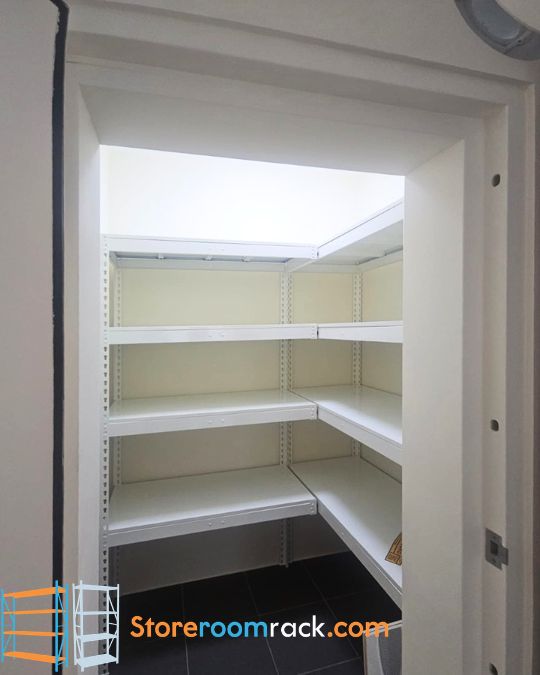
The L-shaped build, in place
How it goes in
Four steps, and only the first one is yours to do. If you are collecting keys on a new BTO, do this before the furniture arrives — an empty shelter is far easier to measure and build in than a full one.
-
Measure the two usable walls
Stand in the doorway and measure wall A and wall B along the floor, then measure the ceiling height and the door opening. Note where the door swing lands and where the vent sits.
-
Pick a length for each arm
The arms are sized independently — 90cm, 110cm or 130cm — so the long wall can take a long bay while the short wall gets whatever is left after the door swing.
-
Choose the tiering
Four levels is the usual build. Raise the bottom shelf if you want luggage and a vacuum standing underneath; go to five or six levels if everything you store is boxed.
-
We deliver and build it in the room
The parts come in flat through the shelter door and the rack is assembled where it stands. Nothing is fixed to the structure, so it can be taken apart and moved again later.
The measuring step is where shelter orders go wrong, and it is worth ten minutes with a tape. Our guide to measuring a storeroom before ordering a rack works just as well for a household shelter, and lists the clearances that catch people out — skirting, door frame return and ceiling height.
What people actually keep in there
Shelters take the things a flat has nowhere else for: luggage, festive decorations, tools, paint, the vacuum, bulk household stock, spare bedding. Boxed items on the upper levels, heavy and awkward things low down, and the things you reach for monthly at chest height.
One habit worth keeping: store in boxes and crates you can lift out quickly rather than loose piles. A household shelter is still a shelter, and everything in it should be able to come out fast if it is ever needed.
If the L-shape is not the answer
Sometimes it genuinely is not. If only one wall in your shelter is usable, a single-bay storeroom rack does the job for less. If you want storage that can be wheeled out of the shelter and folded away entirely, the foldable rack is a better match. And if the room has three usable walls, it is worth reading the layout comparison before committing to two.
Next step
Send us the shelter, we’ll send back a layout
Two wall measurements and a photo from the doorway is enough for us to propose a build: arm lengths, tier count and where the door swing falls. There is no charge for it and no obligation to order.
Prices start at S$160 for a 90cm bay and S$200 for a 130cm bay, both H198cm and 45cm deep, supplied with four shelves.
S$40
Flat delivery anywhere in Singapore.
3 days
Working days from confirmed order to installed.
1 year
Warranty against manufacturing defects.

Frequently Asked Questions
Can I drill into the walls of an HDB household shelter?
No. The shelter is a reinforced concrete box and its walls, floor and ceiling are not to be drilled, nailed or plugged — that includes wall brackets and mounted shelving. A free-standing boltless rack is the way around it: the L-shaped rack with no centre pole locks together by hand and simply stands on the floor, with rubber padding under each leg.
What size rack actually fits a household shelter?
There is no single answer, because shelters vary between blocks and layouts. What is consistent is the method: measure both usable walls, the ceiling height and the door opening, then size each arm to what is left once the door swing is clear. The storeroom measuring guide lists every number, including the clearances people forget.
Will the rack get in the way of the door or the ventilation opening?
Not if it is planned around them. At 45cm deep the rack sits tight to the wall, and the arm on the door wall is simply specified shorter so the door leaf swings past it. The vent is usually high on a wall, so we set the top shelf below it. Send us a photo with your measurements and we will mark both on the layout.
Is an L-shaped rack really better than one straight rack in here?
In most shelters, yes — a single bay uses one wall and leaves the corner and the second wall empty. Turning the corner roughly doubles the shelf area in the same standing space. Where only one wall is genuinely usable, though, a single-bay storeroom rack costs less and is the sensible choice.
How fast can it be delivered, and what happens if something is faulty?
Delivery is a flat S$40 island-wide within 3 working days of a confirmed order, and our crew assembles the rack in the shelter before leaving — see the delivery and shipping policy for access details. Every rack carries a 1 year warranty against manufacturing defects on the frame, beams and shelves under the warranty terms.