Two racks can look identical in a photograph, cost within twenty dollars of each other, and behave completely differently three years into a Singapore storeroom. The difference is almost never the price. It is five details most listings never mention: how the frame joins, how deep the hinge grooves are, whether the legs are welded, what the feet look like, and what the shelves are made of.
This guide walks through all five, with photographs of each pair side by side, so you can tell a rack that will still be square in 2035 from one that will sag by the second Chinese New Year spring-clean.
The short answer
For an HDB storeroom, a BTO household shelter or a condo utility room, the rack you want has every one of these:
| What to check | What good looks like |
|---|---|
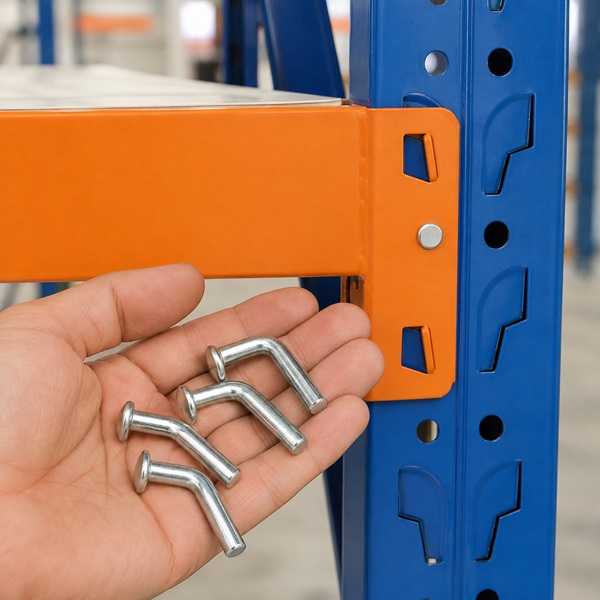
| Assembly | Boltless — shelves hook into the uprights by hand. No bolts to rust, nothing drilled into a shelter wall. |
| Hinge groove | Butterfly, 3cm deep. Keyhole grooves are half that and lift out when knocked. |
| Leg frame | Z-welded, so the pair of uprights is already one rigid frame before a single shelf goes on. |
| Feet | Flat base plates with rubber pads, not bare L-brackets resting on an edge. |
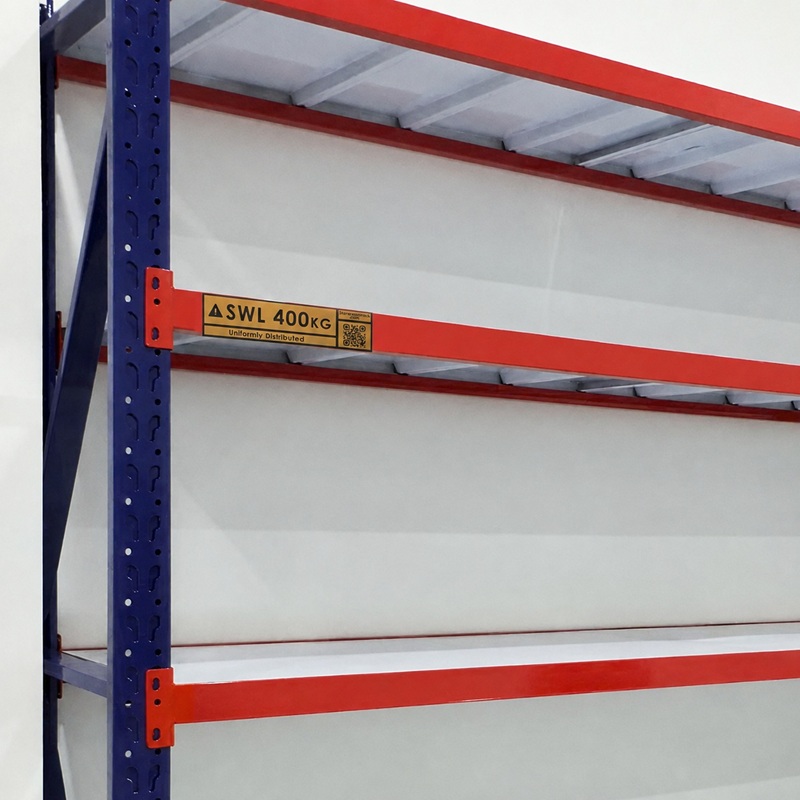
| Shelves | Powder-coated steel. Not plywood, not fibreboard — not in this climate. |
If a rack fails any one of those, keep looking. Here is why each matters.
Boltless vs bolted: why bolts are the first thing to fail
A bolted rack fixes its shelves to the uprights with nuts and bolts. It is the older design, and two things go wrong with it.
The first is rust. Bolts are the one part of a rack nobody powder-coats properly. In a storeroom that sits closed and unventilated most of the year, they are the point where corrosion starts, and a corroded bolt is a joint that has quietly stopped carrying its share of the load.
The second is that bolted racks fight you. Every shelf has to be lined up and threaded on site, which means a long assembly with a spanner in hand. Worse, it makes the rack effectively permanent — moving one shelf up by 10cm to fit a suitcase means loosening and re-tightening a dozen fixings.
A boltless rack hooks together instead. The beams have tabs that drop into slots punched down each upright and lock when tapped home with the heel of your hand. A storeroom bay goes together in about 15 to 20 minutes, with no tools at all; a full-height 200cm warehouse bay is closer to an hour for two people.
In an HDB household shelter that matters twice over, because you are not permitted to drill into the shelter's walls, floor or ceiling. A boltless rack is freestanding — nothing is anchored to the structure, so it goes in without touching the civil defence specification.

Butterfly vs keyhole hinges: 3cm against 1.5cm
This is the single detail that separates two boltless racks that look the same on a product page, and it is worth learning to spot.
Every boltless rack holds its beams in grooves punched down the upright. Butterfly grooves are about 3cm deep. Keyhole grooves are about 1.5cm. That one difference decides how the rack behaves when something goes wrong.
A keyhole groove has only a centimetre and a half of steel holding the beam. It relies on weight to stay seated — so it needs load on it, and it needs more than one shelf tied in before the structure feels solid. Catch a corner with a vacuum cleaner, or lift one end of a lightly loaded shelf while reaching past it, and the beam can hop out of its slot.
A butterfly groove holds twice as much of the beam. The joint stays engaged whether the shelf is loaded or empty, which is exactly what you want on the top level of a storeroom rack — the one that holds light, bulky, awkward things and gets knocked most often.
When you are shopping, ask for a close-up photograph of the upright. The profile is unmistakable once you have seen both.

Z-welded vs straight legs: one shelf or three
Look at the side of the rack rather than the front.
A straight leg frame is four separate uprights. On its own it is four loose posts — the rack only becomes rigid once two or three shelves are in, and those shelves are doing structural work as well as holding your things. It is why cheap racks come with a fixed number of levels and a warning not to leave any out.
A Z-welded frame joins each pair of uprights with welded diagonal bracing before it reaches you. Each side arrives as one triangulated unit, and triangles do not rack out of square. A single shelf panel is enough to tie the two sides together and the whole thing is solid.
The practical payoff is layout freedom. Because the frame does not depend on its shelves for rigidity, you can leave the bottom 90cm completely open for suitcases, a drying rack or a bicycle, and put three or four levels above it. On a straight-leg rack, that empty bay is the thing holding it up — and you cannot have it.
Our guide to building a DIY storage rack goes through the assembly order step by step.

Flat base vs L-shaped base: what the rack stands on
A loaded storeroom rack can put a couple of hundred kilograms onto four small contact points. What those points look like decides whether your floor survives it.
An L-shaped base is a bracket bent from the upright itself. The contact patch is narrow — in places little more than a folded edge — so the load concentrates along a line. On homogeneous tile or vinyl, over years, that line is where you find the mark when the rack finally moves.
A flat base plate is a proper footplate welded across the bottom of the upright. The same weight spreads over a much larger area, which is gentler on new flooring and also makes the rack noticeably harder to rock.
Both types should come with rubber pads, and a reputable supplier will include them either way. The pad is not the point — the plate underneath it is. Ask what is under the rubber.

Steel vs wood shelves: Singapore decides this one for you
Plenty of attractive racks use plywood or fibreboard shelf panels on a metal frame. In a drier climate they are a reasonable choice. Here they are not.
Singapore sits around 80% relative humidity for most of the year, and a storeroom or household shelter is the least ventilated room in the flat — door shut, no window, often sharing a wall with a bathroom. That is close to ideal conditions for mould, and wood is what mould eats. Cellulose is a food source; fibreboard will take on moisture, swell along its edges and begin to sag under a constant load.
Three things follow, and homeowners report all of them:
- A stale smell that transfers to whatever is stored on the shelf — bedding and festive clothing in particular.
- Splintering edges. Once the veneer lifts, every reach into the back of the shelf is a chance to catch your hand.
- A permanent bow. A board that has carried the same boxes for two humid years does not come back flat.
Powder-coated steel has none of those failure modes. It does not absorb water, there is nothing in it for mould to feed on, the coating resists rust, and the surface wipes clean. It is also thinner for the same strength, so you get more usable height per level.

How these racks actually go into HDB and condo homes
The photographs below are real installations, and they cover the four places a rack usually ends up in a Singapore home.
- The storeroom. One straight run along the longest wall, which is what our storeroom rack range is sized around.
- The household shelter. Freestanding, nothing drilled, and sized so the rack clears the shelter door's swing.
- A corner. Two walls worked at once. This is where an L-shaped rack with no centre pole earns its keep — one continuous shelf turns the corner instead of two racks colliding at their uprights.
- The service yard. Above or beside the washing machine, with the bottom bay left open for a drying rack or laundry basket.
Before you choose a size, measure the room properly — and measure the door, because the opening decides what can get in more often than the wall does. Our storeroom measuring guide lists exactly what to write down.

Why white, and not black
Colour is the one item on this list that is purely about living with the thing, and it still matters more than people expect.
A storeroom is small, usually has no window, and is lit by a single ceiling bulb. A white powder-coated rack reflects that light back instead of swallowing it, so you can see what is on the bottom shelf without a torch. Black racks — the industrial look that came into fashion a decade ago — make a 2m² room read as a cupboard.
White also matches what is already there. Shelter doors, service yard walls and storeroom interiors in HDB flats are white or off-white, so the rack disappears into the room rather than announcing itself. And on a practical note, dust shows less on white than on black, which anyone who has wiped a dark rack will confirm.
Putting it together
Run the five checks before you buy: boltless assembly, butterfly grooves at 3cm, a Z-welded frame, flat base plates, and steel shelves. A rack that passes all five costs very little more than one that passes two, and it is the difference between furniture you forget about and furniture you replace.
Not sure which of our ranges suits your room? Compare the rack types side by side, or send us your wall measurements through the quotation form and we will size it for you at no charge.